
After42: Can AI Propose Interesting Research Questions?
TL;DR.In After42, we find that frontier AI models, run in an agentic workflow we built, can propose research questions that experts judge interesting and worth pursuing in some subfields. The workflow starts from a broad, open-ended goal provided by researchers and develops well-formulated questions toward it by attempting to solve them. Across mathematics, statistics, theoretical computer science, and physics, 29 experts judged 45 of its 135 final questions interesting, with wide variation across subfields. We also assess whether AI can judge which questions are interesting: model judges’ shortlists align with expert consensus but do not consistently capture individual experts’ preferences, reflecting how much research taste varies. We release the expert-assessed questions in After42, an open resource we maintain for the research community to discuss, refine, and pursue them, as a step toward integrating AI in research practices.
1 Introduction
Frontier AI systems have recently produced solutions to difficult, well-defined open problems. In mathematics, reported results include a solution to the Navier–Stokes Millennium Problem [1] and the Quasi-Riemann Hypothesis [2]; in computer science, a refutation of the Exponential Time Hypothesis [3]; and in physics, an existence proof for quantum chromodynamics [4] and results on gravitational radiation from cosmic strings [5]. Such problems have become standard tests and showcases for AI capabilities, from the Erdős problems [6] [7] to benchmarks released by mathematicians [8]. This focus has raised two concerns. Tao observes that “good, fruitful open problems” are “now being mined in a non-renewable fashion” [9], and Fields Medalists caution that solving problems is not an end in itself but a “tool and proxy” for conceptual understanding [10]. Both point to what solving posed problems leaves out: posing new questions, developing concepts, theories, and tools, and choosing meaningful research directions [11] [12]. These intertwined activities shape what researchers investigate and aim to understand [13].
Sources [1–13]
- [2]Ten Advances in Mathematics and Theoretical Computer Science
- [3]A $2^{o(n)}$ Time Algorithm for 3-SAT
- [4]Working with academic communities to build scientific understanding
- [5]Solving an Open Problem in Theoretical Physics using AI-Assisted Discovery
- [6]Erdős Problems
- [7]Semi-Autonomous Mathematics Discovery with Gemini: A Case Study on the Erdős Problems
- [8]First Proof
- [9]Post on Mathstodon, 8 September 2026
- [10]A Severe Misalignment of AI in Mathematics
- [11]After Math
- [12]Mathematics in the age of AI
- [13]On proof and progress in mathematics
We study how well current AI systems can assist researchers in this broader enterprise, starting with one part of it: asking research questions. Questions shape where researchers invest their effort, and much of the creative work in research, such as building intuition and formulating precise questions, occurs before any problem is solved [14]. As AI accelerates the solving of posed problems, deciding which questions to ask becomes more consequential. It is also hard, because questions worth pursuing are far fewer than those that can be posed [9]. Explicitly asking a model for interesting questions in a single pass does not overcome this, even when the model is grounded in the relevant literature: in our experiments, most of its initial proposals pass automatic checks for novelty and difficulty, yet experts find few of them genuinely interesting (Figure 2). This raises two intertwined questions.
Q1Can AI propose questions that human experts find interesting?
Q2Can AI judge which questions are interesting?
Both rest on an underlying question: what makes a research question interesting, and to whom? Interestingness is largely a human judgment, shaped by a field’s culture and by each researcher’s taste. Recent work has proposed measurable proxies that capture parts of it, such as the length of a theorem’s proof relative to its statement [15] or the citations a paper goes on to receive [16]. But a system optimized for such a proxy objective can easily drift away from what researchers value. We therefore take an interesting question to be one that researchers in its field judge worth pursuing, and we rely on experts for the final assessment.
To address Q1, we build After42, an agentic workflow whose core idea is to develop new questions by attempting to solve them. It starts from an open-ended goal written by researchers, which sets a broad direction. Grounded in the literature, After42 proposes a large pool of candidate questions toward this goal, filters out weaker ones, and develops the survivors through rounds of solution attempts and revision (Figure 3). In this loop, solving and proposing inform each other: each question directs a solution attempt, and the attempt can reveal where the central obstacle lies or uncover structure that suggests a better question, much as conjectures and concepts are revised in the course of attempted proofs [17].
In our main evaluation with GPT 6 Astra, experts in mathematics, statistics, theoretical computer science, and physics judged about a third of the final questions interesting, with wide variation across subfields: nearly half in phase transitions in random structures, and none in plasma physics (Figure 4). In a separate study in phase transitions using GPT 5.6 Sol, the share of questions that experts judged interesting rose from a few percent of initial proposals to about a third of final questions after filtering and development. In the development trajectories an expert reviewed, solution attempts sharpened questions, redirected them toward a different research target, or corrected the intuition behind them (Section 3.2). Still, most questions we analyzed build directly on known work, and few introduce a new mathematical object and a new line of inquiry (Section 3.4).
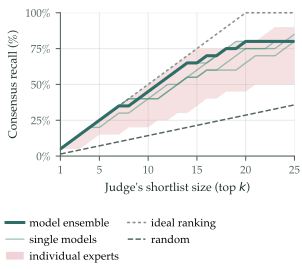
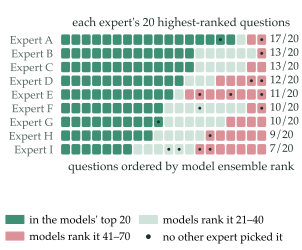
For Q2, we compare how four frontier models and nine experts rank questions in phase transitions, and find that the models’ shortlists capture the questions that experts agree on about as well as individual experts’ shortlists do (Figure 7). Still, model judges cannot yet fully replace human research taste, because it varies across experts: the models’ combined shortlist matches some experts’ top choices far better than others’ and includes few of the questions that only one expert ranked highly (Section 5.1). Conditioning model judges on an individual researcher’s profile can bring their rankings closer to that researcher’s, but the alignment remains limited (Section 5.4). We therefore see model judges as tools that help researchers prioritize, not as substitutes for their judgment.
Intended impact. Our results suggest that, in some subfields, AI can help researchers in this broader enterprise by proposing questions that experts find interesting. AI can explore many more candidate questions than a single researcher could, while researchers set the goals and decide which questions are worth pursuing. Alongside this post, we release the expert-assessed questions in After42, an open resource we maintain for the research community, where researchers can discuss, refine, and pursue these questions. We plan to extend After42 to more fields and invite experts to contribute research goals and assess the resulting questions. Looking forward, we envision researchers and AI jointly building research agendas that lead to deeper questions and new directions.
2 How After42 Works
We build the After42 workflow on the intuition that solving is essential to asking good questions. Researchers rarely pose a strong question at once; they refine it by working on it, for instance by attempting proofs, running experiments, or analyzing data. After42 builds this process into question generation, so that solution attempts drive how each question develops.
The workflow starts from a subfield goal written by researchers, such as the example below. Grounded in a research pack of the literature (Step 0), After42 proposes a broad pool of candidate questions and filters out weak ones (Step 1). It then develops the most promising questions through rounds of solution attempts and revision, with the critic evaluating each proposed change (Step 2; Figure 3).
Example subfield goal: phase transitions in random structuresThe goal of the theory of phase transitions in random structures is to understand how a large number of local random rules produce qualitative change at the macroscopic scale, and to explain what these qualitative changes correspond to in real systems.
The questions of interest are why a system switches abruptly from one type of behavior to another as a parameter varies, where the critical threshold lies, what new geometric, dynamical, informational, or algorithmic structure appears near it, and which phenomena are universal rather than tied to model details. The aim is to discover new phenomena, mechanisms, critical behavior, and universal laws, and to explain why they matter for real systems.
Step 0. Build the research pack. We first build a research pack containing a literature summary, an index of relevant papers and their main results, and open questions collected from the literature. The pack serves as a shared reference for agents throughout the workflow.
Step 1. Propose candidate questions. Interesting questions are rare and difficult to produce in a single pass, so After42 generates a larger pool than the final collection needs.
Proposer agents receive the subfield goal, instructions, and the pack’s literature summary as context. They can consult the pack as needed to propose seed questions, with different hints encouraging diverse proposals. Each seed question undergoes literature checks and short solution attempts to remove duplicate candidates, previously proposed questions, and questions that remain ill posed after attempted repair.
Step 2. Iterative development loop. In each round, solver agents receive an additional budget to try to solve the candidate questions, building on records from earlier attempts or exploring new approaches. These attempts may yield partial results, reveal obstacles, or uncover new structure. For each remaining candidate question, a development agent uses these findings and the literature record to guide further development. It uses multiple subagents to independently explore possible directions, then selects the most promising direction to develop the question further.
Model judges compare the current and revised questions. A revision is accepted only if all judges prefer it. A fresh agent checks the selected question for prior answers, formulation defects, and unsupported claims. It makes minimal repairs that preserve the target or removes questions that remain ill posed. Model judges rank the survivors before the next round. In our mathematics run with GPT 6 Astra, the whole workflow produced 70 final questions in about a day (Appendix A reports runtime and token usage).
Pilot subfields. We chose five subfields across mathematics, statistics, theoretical computer science, and physics as a pilot. In these theoretical fields, solving questions can rely on reasoning, computation, and small-scale experiments. We plan to extend After42 to more fields, such as AI, where research relies more on large-scale experiments.
Expert evaluation. Domain experts assess whether each question is interesting and worth pursuing. The evaluation involves 14 experts in mathematics (8 professors, 1 postdoc, and 5 PhD students), 6 in statistics (2 professors, 1 postdoc, and 3 PhD students), 4 in theoretical computer science (1 professor and 3 PhD students), and 5 in physics (3 professors and 2 PhD students). Every expert-reviewed question was assessed by at least one professor. Experts read the full question, the subfield goal, and related work, and reported spending about 35 minutes per question on average, including written comments. They evaluate the final questions unless an ablation or case study states otherwise.
3 Main Results: Interesting Questions and Where They Come From
3.1 Experts find some questions genuinely interesting
Experts judged 45 of 135 final questions genuinely interesting and worth pursuing. Figure 4 summarizes the evaluations by subfield.
Below we show three questions in phase transitions, a subfield of mathematics, that experts found highly interesting, with quotes from their assessments. Section 5.2 analyzes what makes a question interesting to experts.
Scatter $n$ random points on a sphere in $d$ dimensions and connect two points when they are close, with the threshold set so that each pair is connected with probability about $1/n$. At this density the graph sits at the threshold where large connected clusters first appear. Compare it with a graph that connects each pair independently with the same probability. Geometry makes triangles more likely, since two neighbors of a point tend to be close to each other. When $d$ is of order $(\log n)^3$, is the geometric graph indistinguishable in the limit from the independent graph with a random, Poisson-distributed number of triangles added? This asks whether the entire effect of geometry at this scale is a few extra triangles.
Experts, math-1“We find this question elegant and natural. Dimension of order $(\log n)^{3}$ is the conjectured threshold for detecting geometry in a sparse random geometric graph, and at this scale geometry produces an order-one excess of triangles over an Erdős–Rényi graph. The question asks whether this excess is the entire effect of geometry, that is, whether the graph is asymptotically an Erdős–Rényi graph with an independent Poisson number of added triangles. A positive answer would give a remarkably simple and complete description of the graph at this scale. It would make the triangle count an asymptotically sufficient statistic for detecting geometry, in line with the known role of signed triangle counts in distinguishing random geometric graphs from Erdős–Rényi graphs. Calculations for subgraphs of fixed size support this picture, but they cannot exclude information carried by structures whose size grows with $n$. Thus, at this scale, the question asks whether the departure from Erdős–Rényi is abrupt, with local and global statistics changing together, or gradual, with larger and larger structures departing in turn. This distinction is appealing: in sparse Erdős–Rényi graphs, for example, local structure increasingly determines the extreme eigenvalues as the graph becomes sparser, and it would be great to find a similar transition for random geometric graphs. The scope is somewhat narrow, but it is a very good research problem.”
In the contact process, infected sites recover at rate one and infect each healthy neighbor at rate $\lambda$. On the integer line at the critical rate $\lambda_{\mathbb Z}$, an infection started from finitely many sites always dies out. Now join three half-lines at a single vertex. Each arm alone still dies out at this rate, but the arms can reinfect one another through the junction. Starting with only the junction infected, does the infection survive forever with positive probability at $\lambda_{\mathbb Z}$? This asks whether reinfection through one junction is enough to turn critical extinction into survival.
Experts, math-6“We find this a very interesting problem. At its critical rate, the contact process on the integer line dies out, and the question asks whether a single vertex where three half-lines meet is enough to keep the infection alive. It isolates one simple mechanism, repeated reinfection through a junction. Our one reservation is that the background does not explain why the graph has three arms, so the geometry can look somewhat artificial. Two arms would just give the integer line again, which makes three the smallest new case, and the intuition section relates the question to survival on trees whose edges are replaced by long paths. Stating both points in the background would make the model look much more natural.”
On an infinite square grid, an inactive site becomes active only when at least two neighbors are active. Active sites deactivate at rates chosen randomly and then held fixed. Starting with all sites active, does arbitrarily weak spatial variation make the average fraction of active sites at long times rise continuously from zero as the activation rate increases through the onset of sustained activity? This tests whether randomness can smooth an abrupt transition in a system where complete inactivity is permanent.
Experts, math-7“This is a simple robustness question about generic behavior: does arbitrarily weak quenched disorder smooth out an abrupt transition into an absorbing state? The physical motivation is compelling. A rigorous answer would test a conjecture from the physics literature that quenched disorder smoothes discontinuous transitions in low-dimensional nonequilibrium systems. The question may also connect to robustness questions for the Anderson model and for random perturbations of graphs, and to the contact-process question in this collection ("Can one junction sustain a critical contact process?").”
The After42 workflow raises the proportion of interesting questions. To measure what the workflow adds to its initial proposals, we ran an earlier study in phase transitions in random structures with GPT 5.6 Sol. Unlike the main evaluation, where experts read only final questions, this study also asked experts to judge the initial After42 proposals before filtering and development. The proportion judged interesting rises from 3% of initial proposals to 33% of the final questions from the same run.
3.2 Solution attempts sharpen or redirect research questions
Solution attempts supplied concrete reasons to change a research target. Here we show four trajectories from phase transitions in random structures, each developed over two rounds. In the first, solving opens a new direction that the next round turns into a structural conjecture. In the second, solving finds a comparison that shows the phenomenon more clearly. In the third, solving shows that a first revision still falls short of the goal. In the fourth, solving corrects the intuition behind the original question.
A Poisson subset-sum law for near-optimal lattice paths
Give each vertex of the square lattice an independent exponential reward of mean one. For paths $\pi$ from $(0,0)$ to $(n,n)$ using right and up steps, let $H(\pi)$ be the total reward and $L_n=\max_\pi H(\pi)$, with $L_n/n\to4$.
- Initial question
For $\beta>0$, with $Z_n(\beta)=\sum_\pi e^{\beta H(\pi)}$ and $f(\beta)=\lim_{n\to\infty}n^{-1}\mathbb E\log Z_n(\beta)$, does $\beta[f(\beta)-4\beta]$ approach a finite, positive constant as $\beta\to\infty$?
- Round 1
What solving found. Two attempts wrote out arguments that the constant is $\pi^2/24$. Their calculations traced the correction to local detours near the best path, each flipping a corner of the path at a small cost.
How the question changed. The average alone does not show how these detours combine. The revision let the inverse temperature grow with the path length and asked whether $\log Z_n(n)-nL_n$ converges in distribution to $\sum_{x\in\Pi}\log(1+e^{-x})$, where $\Pi$ is a rate-$1/2$ Poisson process on $(0,\infty)$. Each point of $\Pi$ stands for the scaled cost of one detour, which is either taken or not.
Expert comment“Solving drew attention to the low-cost local detours near the optimal path, and suggested a way to study the random contribution these detours make together. In this step, solving found a more concrete and more explanatory research direction.”
- Round 2
What solving found. Solving proved that $\log Z_n(n)-nL_n$ is asymptotically a sum of terms $\log(1+e^{-n\delta})$, one for each local gap $\delta$, and bounded how often small gaps occur together. Computations on the best four paths showed that two detours that do not interfere can be taken separately or together, and their deficits add. The Poisson limit itself remained unproved.
How the question changed. The revision asked about all near-optimal paths at once. Is every scaled deficit a sum of basic detour costs, with the costs forming a Poisson process? This is the final question.
Expert comment“Compared with studying only the sum of all paths’ contributions, this question describes the relations between different paths more directly. The key idea had already formed in the first round. The value of the second round was to organize these ideas, through path decomposition and numerical computation, into a clearer structure and conjecture.”
- Final question
Does the counting measure of scaled deficits $n[L_n-H(\pi)]$, counting each path once, converge in distribution, vaguely on $[0,\infty)$ as $n\to\infty$, to the counting measure of all finite subset sums of a rate-$1/2$ Poisson process on $(0,\infty)$, including zero?
Macroscopic distance uncertainty in almost identical spanning trees
Give the edges of the complete graph on $n$ vertices independent exponential costs $W_e$ of mean one. Given the costs, sample a spanning tree $T$ with probability proportional to $\exp(-bn^{4/3}\sum_{e\in T}W_e)$, for a fixed $b>0$. Large $b$ favors the minimum spanning tree. Write $d_T$ for the graph distance in $T$.
- Initial question
Does the rescaled tree $(T,n^{-1/3}d_T,n^{-1}\sum_v\delta_v)$ converge in distribution in the Gromov–Hausdorff–Prokhorov topology? Do the limits vary with $b$ and approach the minimum-spanning-tree scaling limit as $b\to\infty$?
- Round 1
What solving found. Solving proved local results but not the full limit. A calculation on a single cycle exposed a blind spot. A spanning tree of a cycle deletes one edge. Averaged over the costs, the deleted edge is uniform at every temperature, so the law of one tree does not change with temperature. Two trees sampled with the same costs can still delete different edges, and distances in them then differ on the macroscopic scale.
How the question changed. The revision fixed the costs and two endpoints, sampled two trees, and asked whether their rescaled distance difference $\Delta_n(b)$ stays positive at every temperature and vanishes as $b\to\infty$. This is the final question.
Expert comment“The original question hoped to find a geometric limit that varies with temperature, but a computation on a simple cycle revealed a blind spot. This change makes the question more focused, and it provides a comparison that shows the phenomenon of interest more clearly.”
- Round 2
What solving found. Solving added proof ideas for the new question, including a lower bound from resampling parts of a tree, a reduction to rooted forests, and the exact limit for an isolated cycle. Positivity at every temperature remained unproved.
How the question changed. Development proposed asking for the exact rate at which the difference vanishes, namely whether $b_n\Delta_n(b_n)$ tends to one constant for every sequence $b_n\to\infty$. Three model judges each compared it with the current question, and two of the three preferred the new version. A revision is adopted only when all judges prefer it, so the second-round update was not adopted.
Expert comment“The second round helped explore how to solve it, but brought no new change to the final question. The main improvement to the question itself happened in the first round.”
- Final question
Sample two trees $T^{(1)},T^{(2)}$ independently given the same costs, and choose vertices $U,V$ uniformly at random. Let $\Delta_n(b)=\mathbb E\bigl[\min\{1,n^{-1/3}|d_{T^{(1)}}(U,V)-d_{T^{(2)}}(U,V)|\}\bigr]$. Does $\Delta_n(b)$ converge to a limit $\Delta(b)$ that is positive for every $b$ and tends to $0$ as $b\to\infty$?
A zero-temperature interface in a fixed random environment
At low temperature, the boundary between the plus and minus phases of a planar Ising model is a random interface. A weak random field rewards the signed area that the interface sweeps out. In the continuum, write $B$ for a Brownian bridge on $[0,1]$, $W$ for Gaussian white noise on $[0,1]\times\mathbb R$, and $W(g_x)$ for the noise integrated against $g_x(t,y)=\mathbf 1_{\{0<y<x(t)\}}-\mathbf 1_{\{x(t)<y<0\}}$, the signed region between a path $x$ and the axis.
- Initial question
In the box $\{0,\ldots,L\}\times\{-L,\ldots,L\}$ at large fixed inverse temperature, impose plus boundary spins above height zero and minus below, and add independent Gaussian fields of strength $\lambda L^{-3/4}$. Given the field, does the law of the rescaled interface height $L^{-1/2}H_L$ converge to the law of $B$ tilted by a density proportional to $\exp\{c\,W(g_B)\}$, for an explicit constant $c$?
- Round 1
What solving found. Both attempts wrote out arguments that the proposed continuum limit holds. Computing the thermal fluctuations of the interface in this continuum model then showed that, as the influence of the random field grows, the interface should concentrate on a single random curve.
How the question changed. The revision moved to the continuum model itself. Weight $B$ by a density proportional to $\exp\{c\,W(g_B)\}$ and let $c\to\infty$. After heights are rescaled by $c^{-2/3}$, does this measure converge to a point mass at a random curve $X_*$ that is not deterministic?
Expert comment“The first round computed the interface’s thermal fluctuations and found a phenomenon worth pursuing. The value of this round is that solving moved the research from building a model to the geometric phenomenon the model itself exhibits.”
- Round 2
What solving found. Solving proved that along subsequences the limit is a point mass at a random curve, and that two interfaces sampled at the same low temperature come together. It could not show that every subsequence gives the same curve. As the temperature decreases further, the shared curve might still change, and convergence of the laws of the shape would not detect this.
How the question changed. The revision rewrote the model at temperature $\varepsilon$ with one fixed noise $W$, and asked whether cooling selects a single curve determined by the noise. This is the final question.
Expert comment“To answer the shape question raised in the first round, one also needs to know whether this dependence on temperature eventually stabilizes. I find this step very valuable. Solving made clear which step was still missing between the existing results and the goal, and turned that step into a more concrete question.”
- Final question
At temperature $\varepsilon>0$, let $\mu_{\varepsilon,W}$ be the law of $\sqrt\varepsilon B$ reweighted by $\exp\{\varepsilon^{-1}W(g_x)\}$, with the same noise $W$ at every temperature. Is there a curve $X_*(W)$, determined by the noise, such that $\mu_{\varepsilon,W}$ converges in probability to the point mass at $X_*(W)$ as $\varepsilon\downarrow0$?
A Poisson triangle representation of sparse geometry
This is the question of Example 1, now followed through its development. Sample $n$ independent uniform points on the unit sphere in $\mathbb R^d$. Join pairs whose inner product exceeds a threshold giving edge probability $p_n=(1+\lambda n^{-1/3})/n$, for fixed $\lambda\in\mathbb R$. Compare this geometric graph with an Erdős–Rényi graph having independent edges of probability $p_n$.
- Initial question
Find the dimension scale where geometry becomes hard to detect and characterize the log of the geometric-to-Erdős–Rényi probability ratio. Can this log-ratio be recovered from breadth-first queue-length histories and non-tree edge locations of components with order $n^{2/3}$ vertices?
- Round 1
What solving found. At $d\sim c(\log n)^3$, the attempts derived a Poisson number of triangles with mean $e^{\sqrt{8/c}}/6$, against $1/6$ under independent edges. They showed that triangles usually lie outside the large components that the initial question focused on, and that the records of those components cannot recover the probability ratio. If any finite family of cycle counts suffices, triangle counts alone suffice.
How the question changed. The revision replaced the separate detection targets with one generative model. Add a Poisson number of uniformly random triangles to the Erdős–Rényi graph. Is the result asymptotically equal to the geometric graph in total variation? This is the final question.
Expert comment“Solving gradually corrected the intuition about where the geometric information is hidden. This rewrite organized the originally scattered questions into an intuitive generative mechanism, and also corrected the initial direction of the search for geometric information.”
- Round 2
What solving found. Solving asked what difference remains once the triangles are added. It showed that, up to a growing size, other local structures carry no extra geometric information. Patterns with many more edges than vertices remained out of reach.
How the question changed. The question was kept. Total variation requires all graph-event probabilities to agree asymptotically, so the question asks whether triangles explain every difference between the two graphs.
Expert comment“The key question that ultimately needs to be solved remains whether triangles are enough to explain all the differences in the whole graph. The second round further clarified the hardest step this conjecture has to cross.”
- Final question
When $d/(\log n)^3\to c>0$, is the geometric graph asymptotically equal in total variation to Erdős–Rényi plus $M$ added triangles, where $M\sim\operatorname{Pois}((e^{\sqrt{8/c}}-1)/6)$? Independently of the base graph, sample $M$ and choose $M$ independent uniform three-element vertex subsets, allowing the same subset to repeat. Add all three edges within each subset.
3.3 Results remain uneven across fields
The proportion of final questions that experts judged interesting varies widely across subfields (Figure 4). It ranges from 47% in phase transitions in random structures, a subfield of mathematics, to 0% in plasma physics. Subfields more closely related to mathematics tend to have higher proportions of questions judged interesting. Black hole ringdown (general relativity) and online algorithms reach 38% and 33%, respectively, compared with 14% for prediction-powered inference, a more methodology-driven subfield of statistics, and 0% for plasma physics.
3.4 Most questions build directly on known work
We define composition as generating questions that build directly on known work, for example, by recombining or modifying elements of existing work, or taking the next step on a known object. In our mathematics sample, 97 of 100 initial proposals and 61 of 70 final questions fall into this category (Figure 5). Composition can produce strong questions, including extensions of existing work that experts found interesting. However, major research advances can arise from questions that go beyond composition. For example, Broadbent and Hammersley (1957) [18] introduced percolation to model flow through a random medium, while Erdős and Rényi (1960) [19] studied how random graphs evolve as edges are added. Such questions are rare among our proposals, suggesting a limitation of current AI question generation.
4 Failure Analysis: When Proposed Questions Fail
To understand where question generation still falls short, we summarize recurring weaknesses identified by experts.
Weak questions exhibit recurring problems in research motivation and formulation. Expert comments on weak questions point to three recurring problems.
- Unnatural combination. The components do not interact in a meaningful way, so together they do not form a compelling research target.
- Engineered complexity. Added assumptions, parameters, or constructions make the problem harder without isolating a meaningful phenomenon.
- Unclear contribution beyond prior work. The question does not make clear what it adds to existing results or previously posed questions.
The examples below give a condensed version of one question for each problem.
Summarized question
Can fragmented networks remember their initial opinions?
Start from a uniformly random $4$-regular graph on $n$ vertices with independent uniform opinions $\sigma_i(0)\in\{-1,1\}$. At each step, pick a uniformly random edge whose endpoints disagree. One endpoint, chosen at random, adopts the other’s opinion with probability $1-r$, and with probability $r$ replaces the edge by one to a random non-neighbor that shares its opinion. The process stops when no such edge remains, leaving a final graph $G_\infty$. Let $\mathcal R_n(r)=\sup_{\widehat{\sigma}}\mathbb E\bigl|\frac{1}{n}\sum_i\widehat{\sigma}_i(G_\infty)\sigma_i(0)\bigr|$ be the best overlap with the initial opinions achievable from $G_\infty$ alone, and let $L_2(G_\infty)$ be the size of its second-largest component. For every fixed $r\in(0,1)$, is it true that
Expert comment“I do not particularly like this question. It ties two hard problems directly together, the combination feels forced, and it does not explain why the question should be posed this way.”
Summarized question
Aging of return probabilities on a critical tree
Fix $d\ge3$ and $0<\gamma<1$. On an infinite $d$-regular tree, each edge has an independent renewal clock with waiting times satisfying $\mathbb P(T>s)=(1+s)^{-\gamma}$. At time zero and each renewal, the edge is independently declared open with probability $1/(d-1)$, the critical percolation probability.
A walker $X_t$ starts at the root. At the times of an independent rate-one Poisson clock, it chooses a uniformly random neighbor and moves there only if the connecting edge is open.
For every $\theta>0$, show that
exists, and determine it.
Expert comment“The question is meaningful and could distinguish two aging mechanisms. With three layers of randomness combined, however, the central question no longer stands out.”
Summarized question
Does pinning the core preserve singular response?
Sample $G\sim G(n,c/n)$ with $c$ above the threshold for a rigid component of linear size, place the vertices at independent standard Gaussian points in the plane, and treat each edge as a spring. Let $K_n$ be the stiffness matrix of the largest rigid component, which has $r_n$ vertices. Let $A_n$ be its restriction to the vertices outside the component’s $3$-core, which describes the response when the core is held fixed. Define
Prove or refute that there exist $B(c)$ and $\eta_0(c)>0$ such that, for every fixed $0<\eta<\eta_0(c)$, the inequality $\chi_n(\eta)\le B(c)\,p_n(\eta)$ holds with probability tending to one.
Both reviews describe it as a lemma within an existing line of research.
Expert comment“I usually like spectral questions, but comparing full and core-pinned responses feels more like a lemma in a rigidity project than a standalone problem.”
Scientific writing problems occur in both strong and weak questions. Incorrect terminology and nonstandard phrasing can obscure the intended meaning. The motivation and essential explanations are often compressed or omitted, while routine details receive excessive attention.
5 Research Taste: Do Model Judges Agree with Experts?
We now examine whether model judges can identify which questions are interesting. Figure 6 compares how model judges and experts evaluate questions.
Which questions are most interesting and worth pursuing?
- SimplicityFew essential objects, one core target
- Boldness and naturalnessChallenge the standard framing; no routine A+B
- DepthDeepen understanding or leave a reusable idea
- Difficulty is not a negativeDo not favor what merely looks tractable
Is this question genuinely interesting? Would you pursue it, or suggest it to a student?
- None givenExperts rely on their own judgment
5.1 Model judges align with expert consensus but cannot yet replace individual research taste
We first assess how closely model judgments align with expert consensus and individual experts’ preferences. Four models (GPT 5.6 Sol, Astra, Fable 5.1, and Opus 5.5) and nine experts rank the same set of 70 final questions produced by our workflow in phase transitions, a subfield of mathematics. We focus on shortlists of the questions each judge ranks most highly.
Model shortlists align with expert consensus. We aggregate experts’ top-20 selections to form a fixed 20-question expert consensus set. We then measure how many of these questions appear in each model’s or expert’s top-$k$ shortlist. At $k=20$, individual models achieve 65–80% consensus recall, compared with 45–80% for individual experts. The ensemble ranking obtained by averaging ranks across the four models achieves 80% recall (Figure 7, left).
Alignment with expert consensus does not imply alignment with individual experts’ research tastes. The model ensemble’s top-20 shortlist achieves 35–85% recall of individual experts’ top-20 selections (Figure 7, right). Recall as low as 35% matters because individual experts may recognize breakthrough potential that others overlook.
5.2 What experts look for in a question
Although experts received no criteria (Figure 6), four recurring themes emerge from their written comments.
- Naturalness. Experts favor questions with a clear motivation within the field and a single main objective, and criticize combinations of familiar ideas whose connection is not well motivated.
- Deeper understanding. The answer would deepen understanding of the field. For example, the question addresses a phenomenon that is not yet explained, ideally one where either outcome would be informative.
- Need for new ideas. Experts valued extensions that call for new ideas. The formulation should explain why the particular quantitative target is of interest.
- A tractable starting point. The question admits a concrete first step that is worth doing on its own.
We illustrate these themes with three questions that most experts ranked highly.
Do optimal matchings differ on a large scale?
In a sparse random network, pair up as many linked vertices as possible. There are usually many optimal pairings. Take two of them at random and look at where they differ. Do the differences form chains that span a positive fraction of the network, and if so, above what edge density does this occur?
What experts value. Six of the nine experts rank this among their top five. The random-graph model is a natural setting, and the question asks for a sharp structural change. Either answer would clarify the structure of its optimal matchings.
Expert comment“I appreciate that this is easy to state and asks for a sharp structural change among optimal matchings, with either macroscopic exchanges or genuine rigidity teaching us something.”
Can removing an inactive constraint move the optimum far away?
In dimension $d$, sample $3d$ random constraints and find the point on a sphere that satisfies all of them with the largest margin. Some constraints are not tight at this optimum, so removing one of them changes nothing nearby. Can it still move the optimum to a distant point?
What experts value. Seven of the nine experts rank this among their top 15. A positive answer would show that local stability does not determine which solution is globally optimal.
Expert comment“This phenomenon is very counterintuitive. A constraint that seems to have no effect could still change the global optimum, which I find very interesting.”
How are near-optimal paths built?
Put a random reward on each site of a grid and consider all up-right paths between two corners. The proposal is that the next-best paths are the best path modified by a few small, separate detours, so that their shortfalls add up from independent pieces. Is the rescaled list of shortfalls described by the sums of all finite subsets of a random scatter of points?
What experts value. Seven of the nine experts rank this among their top 15. One expert values the description of near-optimal paths through elementary local changes as a worthwhile first step, even if establishing the full distribution is difficult.
Expert comment“Although specialized, the Poisson subset-sum picture gives an intuitive way to understand how near-optimal paths are built from elementary local changes.”
5.3 Where models and experts disagree
We wrote the instructions for our model judges before the expert study. Most of the themes that later emerged from expert comments turn out to appear already in these instructions (Figure 6), and the judges’ explanations of their rankings invoke the same considerations. Unlike the other themes, tractability is not emphasized in our instructions to the model judges. Many experts value a concrete first step, whereas the instructions tell the judges not to prefer a question because it appears more tractable. As a result, the model judges may rank highly questions that offer no clear starting point.
In some cases, models and experts agree closely. However, disagreements often arise because models and experts interpret the same criterion differently. In the first example below, experts rank the question much higher than models do: models judge the stated conjecture and find its mechanism predictable, while experts value what either a proof or a counterexample would reveal. In the second, models rank the question highly, whereas some experts criticize it: models find a mechanism linking the ingredients and therefore judge the combination natural, while the experts see a routine A+B combination and doubt that the interaction yields new understanding.
Do extra triangles account for geometric dependence?
Place points at random on a high-dimensional sphere and connect each pair that is close. At the dimension where geometry becomes barely detectable, the resulting sparse network looks almost like one with purely random connections, except that it contains a few more triangles. Is that the whole difference? Is the geometric network indistinguishable from a purely random network with a random number of extra triangles added?
The disagreement. Eight of the nine experts place this question in their top 15. The four-model ensemble ranks it 36th. Fable and Opus read it as a sharp refinement of a known threshold for detecting geometry, with a predictable mechanism and a parameter that plays no role. Experts value what either a proof or a counterexample would reveal about geometric dependence.
Experts; Erdős–Rényi means a network with purely random connections“Calculations for subgraphs of fixed size support this picture, but they cannot exclude information carried by structures whose size grows with $n$. Thus, at this scale, the question asks whether the departure from Erdős–Rényi is abrupt, with local and global statistics changing together, or gradual, with larger and larger structures departing in turn.”
Can a shuffled permutation reveal hidden communities?
Split $n$ items into two hidden communities and apply about $cn$ random swaps, favoring pairs within the same community. Only the final permutation is observed. For which $c$ can the communities be recovered better than chance, and is this information lost again as $c$ grows?
The disagreement. All four models rank this among their top six of 32. They see a single mechanism: the cycle structure of the final permutation carries no information about the communities, so any signal must lie in where each item ends up. Two experts instead see a combination of Markov-chain mixing and community detection without a convincing reason to study them together.
Expert comment“This currently feels like an ‘A + B’ problem, combining Markov-chain mixing with weak recovery. […] Why is this particular combination intrinsically worth studying?”
5.4 Personalizing model rankings
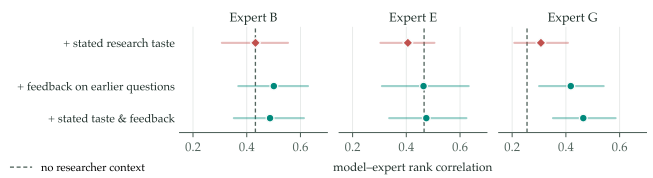
For each of three experts, we give Astra the expert’s description of their research preferences, their feedback on 33 earlier After42 questions, or both. The description includes qualities the expert values and papers they like or dislike, with explanations.
Stated preferences do not improve alignment. Adding stated preferences does not improve agreement with the expert’s ranking (Figure 8). The stated preferences largely overlap with the judging criteria already provided to Astra.
Feedback on earlier questions improves alignment. Feedback shows how an expert applies these principles to concrete questions. It raises the correlation with one expert from 0.26 to 0.42, with smaller increases for the other two. Adding stated preferences to feedback yields no further clear gain. Earlier judgments produce closer agreement with the experts’ rankings than stated preferences alone.
6 Limitations and Future Steps
- A snapshot of current models. Our results describe frontier models available in September 2026. Capabilities change quickly, so the specific numbers in this post will likely be outdated soon; we report them as a dated record and release the questions and assessments so that later work can build on them.
- Evaluation scale. We have no reliable automatic evaluator of interestingness, so final assessments rely on experts, whose limited availability constrains scale. Our evaluation covers a limited set of questions, subfields, and experts: the comparison of model and expert rankings covers a single subfield, and the profile-conditioning experiments use profiles from only three experts.
- Expert interest as a proxy. Experts’ judgments of interest are an early, imperfect signal of the research value that pursuing a question could yield. Researchers can misjudge, and a field’s consensus can overlook directions that later prove important, which is one reason individual judgments matter alongside consensus. Whether resolving the proposed questions produces valuable insights remains to be established.
- Cultural and empirical aspects of interestingness. What makes a research question interesting is shaped by both research culture and empirical evidence. A field’s literature and traditions influence which questions researchers value, while new data and observations can motivate new questions. After42 draws on the cultural aspect through the literature and researchers’ goals, but does not yet gather new evidence from data, simulations, or experiments, and our pilot covers only theoretical fields. Gathering such evidence to guide question development, and extending After42 to fields that rely on experiments, are important next steps.
7 Discussion
Asking and solving are intertwined. Solving an open question often requires posing new questions and developing new concepts, theories, and tools, and these developments can in turn reshape the original question [17]. After42 uses a simplified form of this process: in the trajectories an expert reviewed, attempts to solve a question sharpened it, redirected it toward a better target, or corrected the intuition behind it (Section 3.2). More broadly, posing and solving questions are how researchers build understanding [13], and as AI produces ideas faster than researchers can absorb them, the work of understanding those ideas is likely to grow rather than shrink [20].
Who decides what is interesting. Research taste is diverse: experts agree on some questions and diverge on many others. Model judges, by contrast, behave like mode seekers: they recover the questions that experts agree on, but do no better than chance on those that only one expert ranked highly (Section 5.1), and such questions sometimes open new directions. More fundamentally, what counts as interesting is judged by researchers, informed by evidence and shaped by the culture of their fields and their individual taste; a model can approximate these judgments but cannot define them. We therefore argue that the research community, rather than any model or metric, should decide what makes a research question worth pursuing.
Potential risks. The concerns discussed in Section 1 apply to our own work. A public collection of vetted questions could become another benchmark, or draw automated attempts before researchers have had time to work on the questions, and the Fields Medalists’ declaration also warns that rushed announcements raise “severe attribution and plagiarism questions” [10]. We release the questions for researchers to pursue, not as a benchmark for AI systems, and ask that work building on them credit their source and disclose any AI assistance.
Sources [10]
An invitation to researchers. The questions are available in our question collection for researchers to pursue, revise, or challenge. Three researchers have begun studying three of the physics questions. We invite researchers to help extend After42 to more fields by setting research goals and sharing their expertise, and we welcome comments and suggestions for improving the published questions. The contributor page describes how we maintain After42, license the questions and expert comments, and credit contributors.
Acknowledgements
We thank Yuanxi Liu, Xiaodong Tao, Bohan Zhang, Gan Luo, Ken Ziyu Liu, Haotian Ye, Rui Li, Haimeng Zhao, and Lei Wu for their valuable feedback. We are also grateful to Yufei Zhao, Hong Wang, Nicolas Flammarion, Jason D. Lee, and Dylan Foster for their insightful advice.
Appendix
A. Runtime and Token Usage
Runtime. As an example, our mathematics run with GPT 6 Astra produced 70 final questions in about a day. Generating and filtering 10 batches of initial proposals took roughly 11 hours, followed by 12 hours of development with up to 16 questions developed in parallel. Lead agents and subagents together used about 260 agent-hours (3.7 per final question).
Token usage. For the same run, we estimate token usage from successfully completed turns of lead agents and subagents. The total is about 2.62 billion tokens (37.4 million per final question).
| Token category | Approximate count |
|---|---|
| Uncached input | 211 million |
| Cached input | 2.38 billion |
| Output (including reasoning) | 24.9 million |
| Total | 2.62 billion |
Cite this work
@misc{nie2026after42,
  title  = {Can {AI} Propose Interesting Research Questions?},
  author = {Nie, Fan and Wang, Zihao and Wen, Kaiyue and Wen, Garrett and Wang,
            Zhaozi and Wang, Hai-Yang and Wu, Denny and Misiakiewicz, Theodor and
            Bruna, Joan and Li, Shuangping and Li, Puheng and Sun, Rui and Ma,
            Renyuan and Xu, Sheng and Zhang, Yiran and Latourelle-Vigeant, Hugo
            and Wang, Ruixiao and Zhang, Linjun and Dong, Yijun and Yang, Mingwei
            and Bietti, Alberto and Gupta, Anupam and Wang, Tianhao and McKenzie,
            Theo and Zeng, Shuzhe and Chen, Yanbei and Philippov, Alexander and
            Most, Elias Roland and Li, Xiang and Kim, Juno and Zou, James and
            Montanari, Andrea and Liang, Percy},
  year   = {2026},
  url    = {https://after42.org/research/can-ai-propose-interesting-research-questions/}
}